Lattice v17. A new world for every war.
Generate a world from a seed, from a quick duel to a galaxy of twelve empires. Build on the land you hold. Forge your own lanes. Then watch it all back.
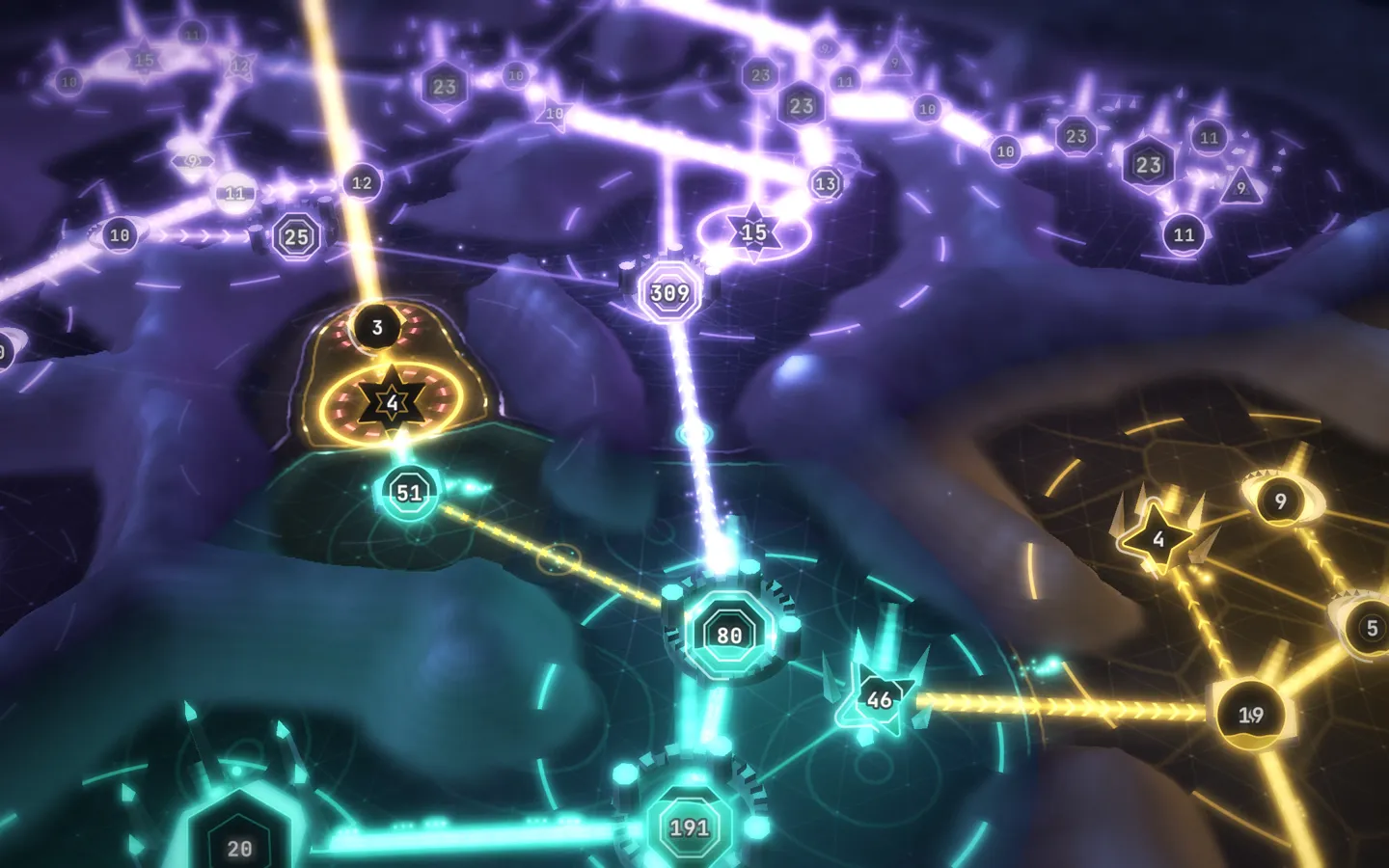
In v16, we made the world bigger. In v17, we hand it to you. Generate a new world for every war, from a quick duel to a galaxy of twelve empires. Rebuild the land you hold, forge new lanes across it, and raise a structure only your faction can build. Then watch the war back, and share how it ended. v17 is live now.
Every world, a new one.
Open the World Forge from the main menu and build a world from a seed. Roll a new one, or type a seed to share a world with a friend. Pick a shape. Constellation scatters star systems with many routes between them. Spiral wraps galactic arms around a crowded core. Archipelago strings island clusters together with narrow bridges. Halo sets a ring of systems around a lone heart. The classic maps are still there too.
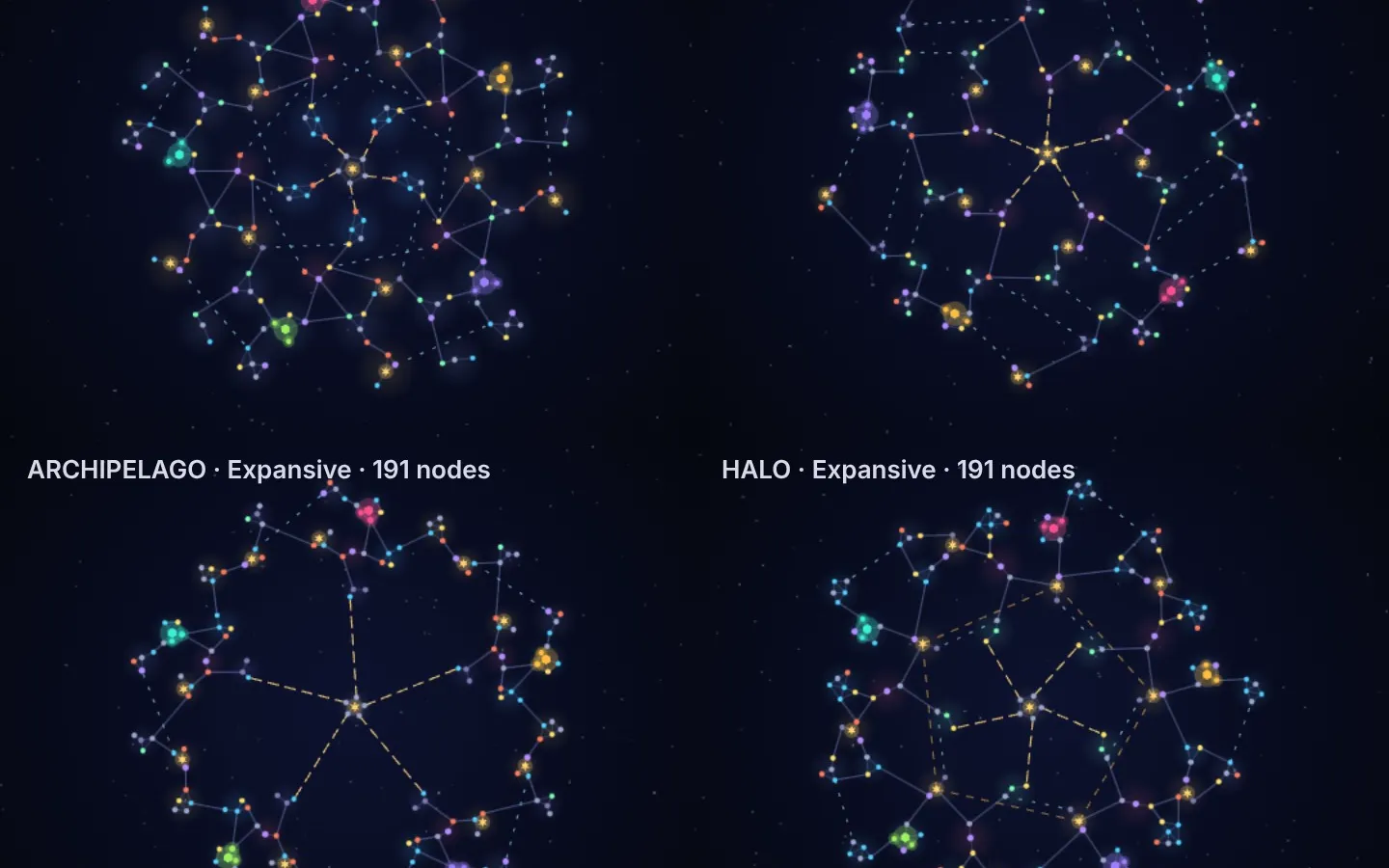
Up to twelve empires.
Worlds come in five sizes. A Compact war is over in ten minutes or less. A Vast one, with up to nine empires on some 360 nodes, runs for an hour or more. And a Colossal world holds about 700 nodes and up to twelve empires: a war that lasts for hours, so save it and come back. Set the rules too: win on score or by conquest, with a time limit or none. On a bare world, every node but the cores and spires starts empty, and the empires build the whole world themselves.
Star systems. Every world is a set of named star systems, linked by only a few lanes. Some have a single way in, so hold that lane and everything behind it is safe. Hold every node in a system, and it’s your dominion: faster growth, harder shells, and its name lit up in your colour. And every node has a name, so a war tells its own story.
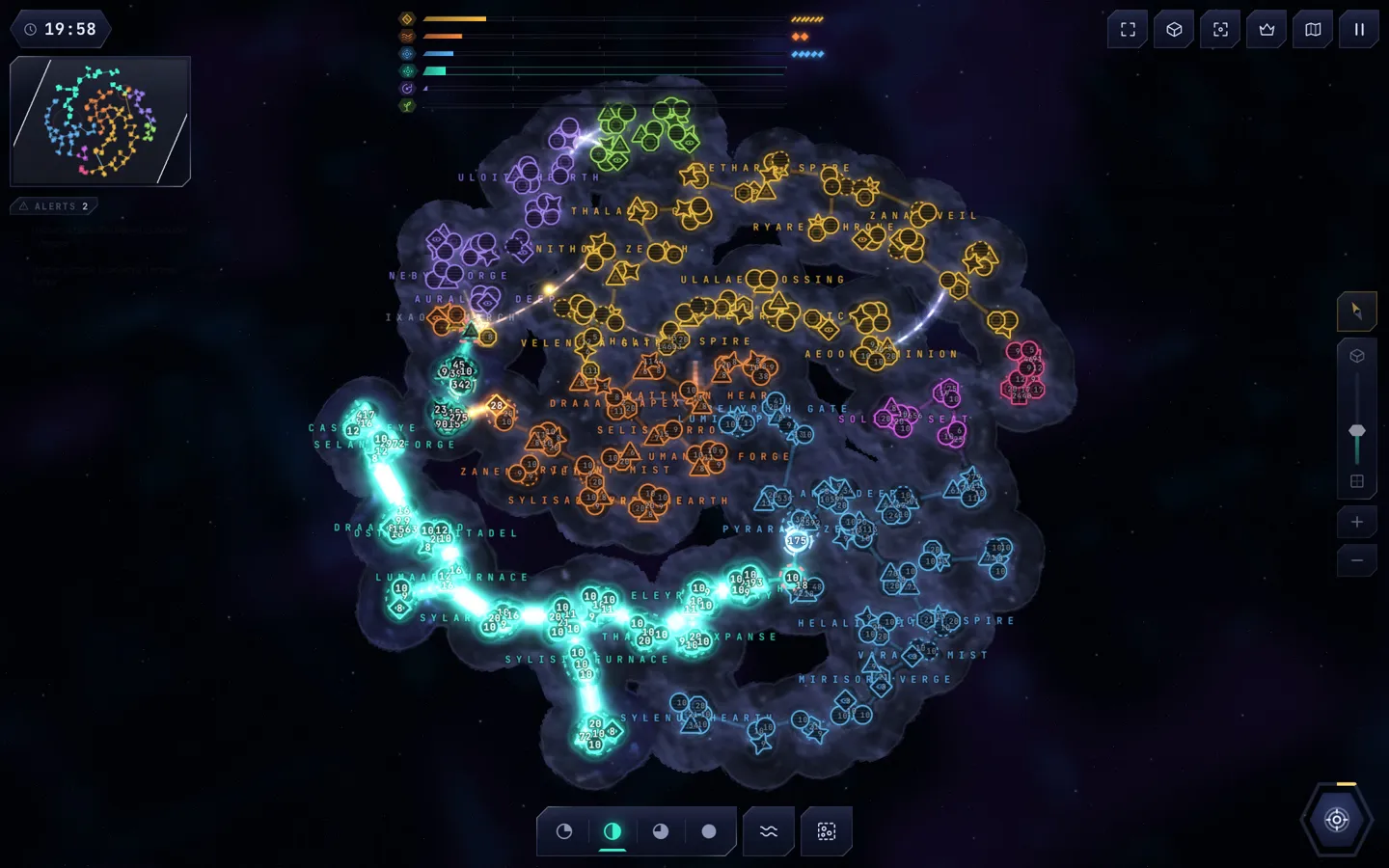
The map moves, too. The central system starts sealed behind golden gates. Rift tides open fast wormholes between distant systems, then close them again, taking anything still inside with them.
Build on what you hold.
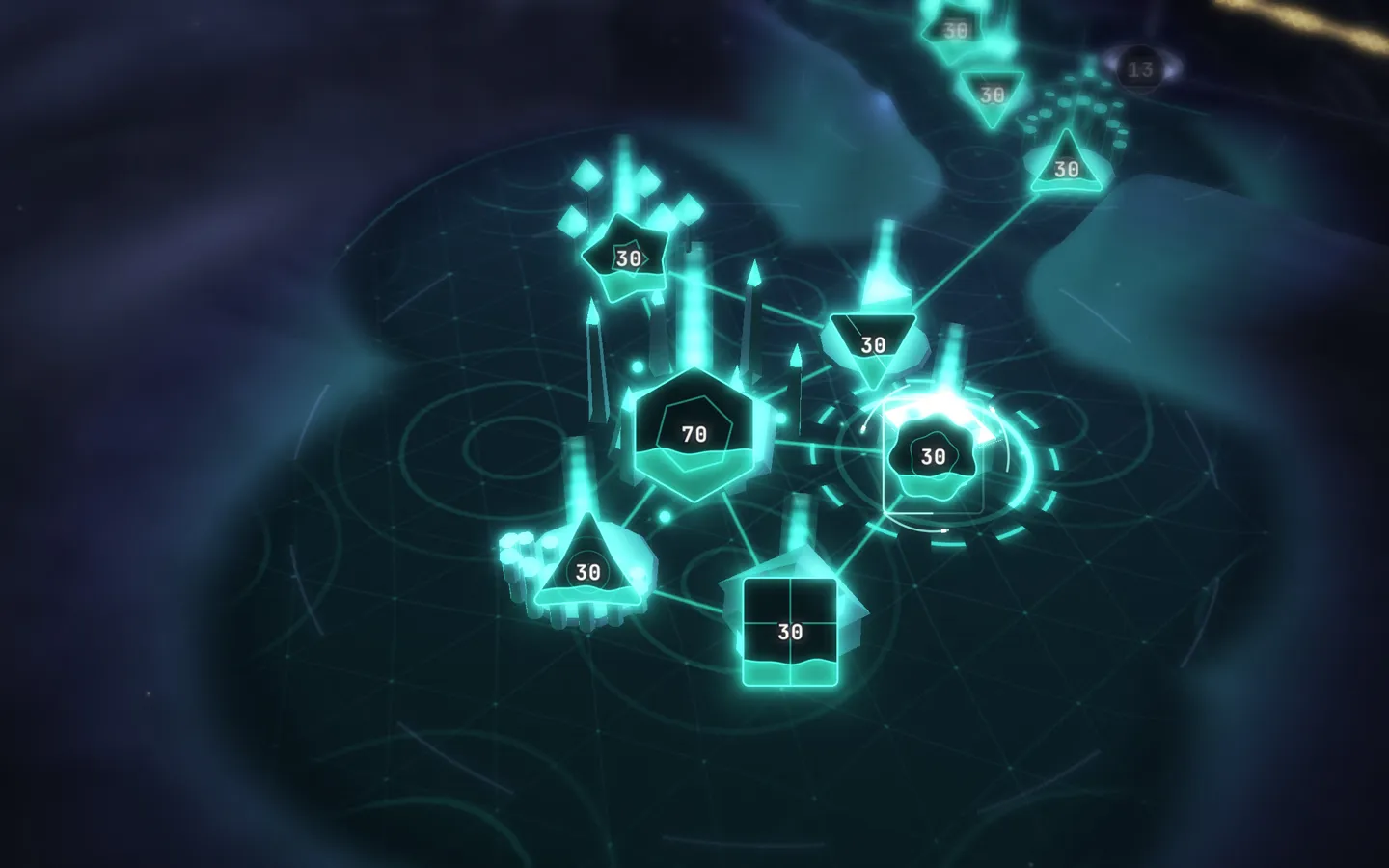
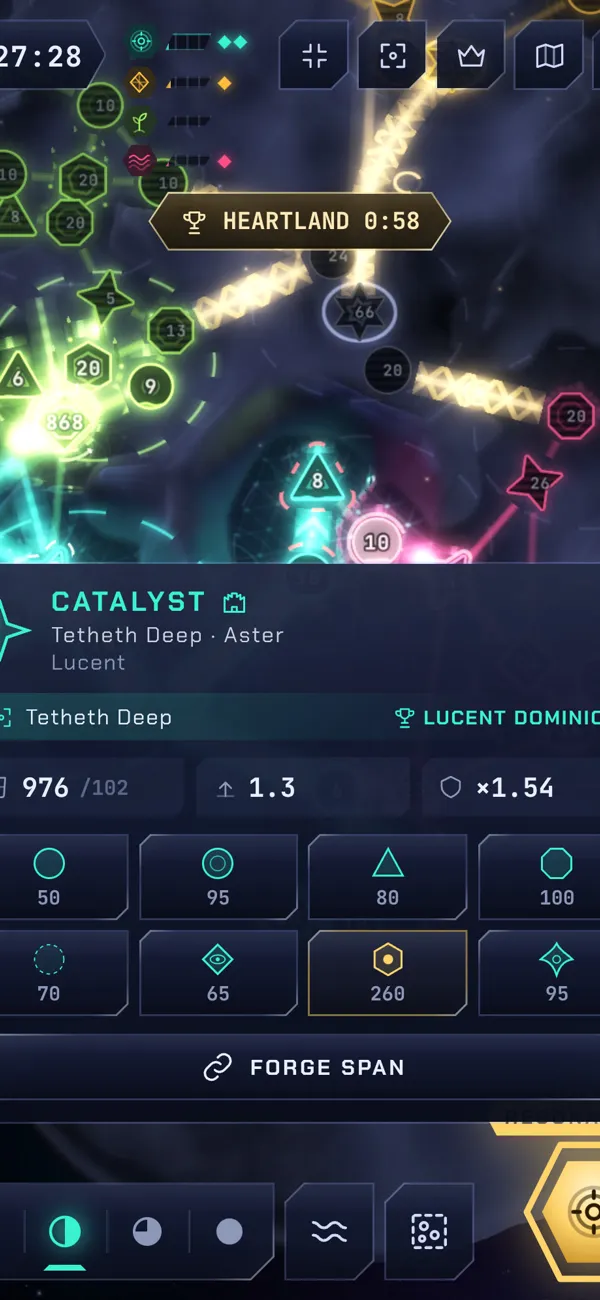
Any node you hold, except a core or a spire, can now become something else. Tap it and choose: a hub, a well for fast growth, a bastion with a hard shell, a relay that feeds up to three rivers at once, a catalyst for harder strikes, a veil to hide your garrison, a lens to see into the fog. Or a whole new core. You pay with the mass on the node while it builds, so everyone can see what you’re making. And if they take it first, the work is lost.
Where you build matters. Structures lend their strength to your nodes beside them: a bastion hardens its neighbours, a catalyst sharpens their strikes, a relay speeds their launches. The node’s card marks the structure that suits it in gold, and tells you why.
A signature for every faction. Each faction has a structure only it can build. The Lucent’s Choir makes every strike converge, even alone. The Bloom’s Tidepool surges every node around it when it’s struck. The Aureate’s Prism hits harder the further its strikes travel. The Violet Synod’s Reliquary gathers forces lost nearby and brings them back. And the Verdant Host’s Grove supplies the land around it like a core.
Forge your own lanes. Don’t like the map? Change it. Forge a span between two of your nodes, and you have a new lane where there wasn’t one. It’s a big commitment: it costs mass, takes about twenty seconds to build in plain sight, and falls the moment you lose either end. Reach a neutral node instead, and you have twenty seconds to take it before the bridge collapses.
Five wars. One saga.
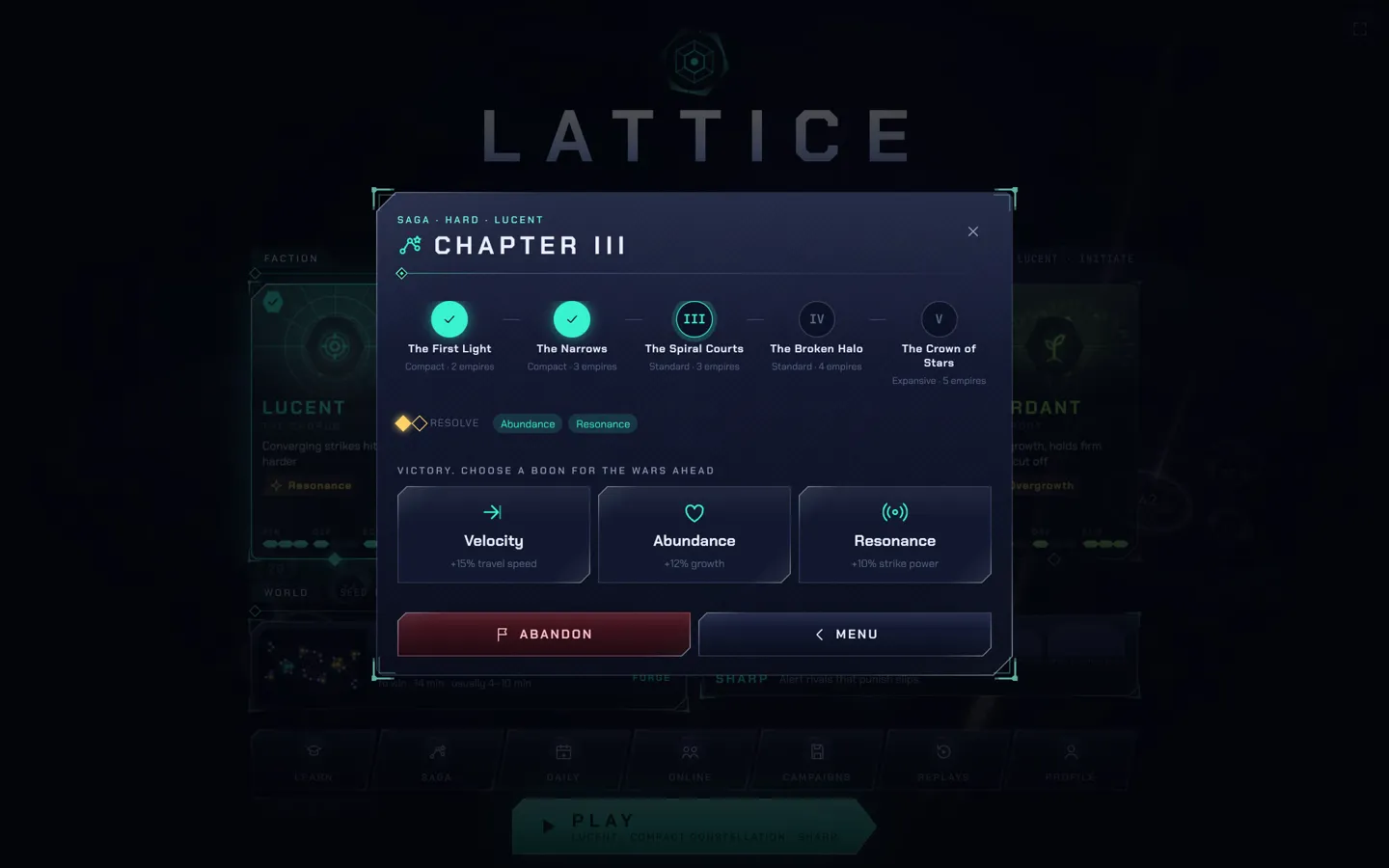
Saga is a new way to play: a run of five wars, each bigger than the last, from The First Light to The Crown of Stars. Win a war, and choose a boon to carry into every war after it. Lose one, and it costs you a point of resolve before you fight again on a new world. Run out, and the saga ends. Choose your pace: Gentle, Hard or Brutal.
Watch it back.
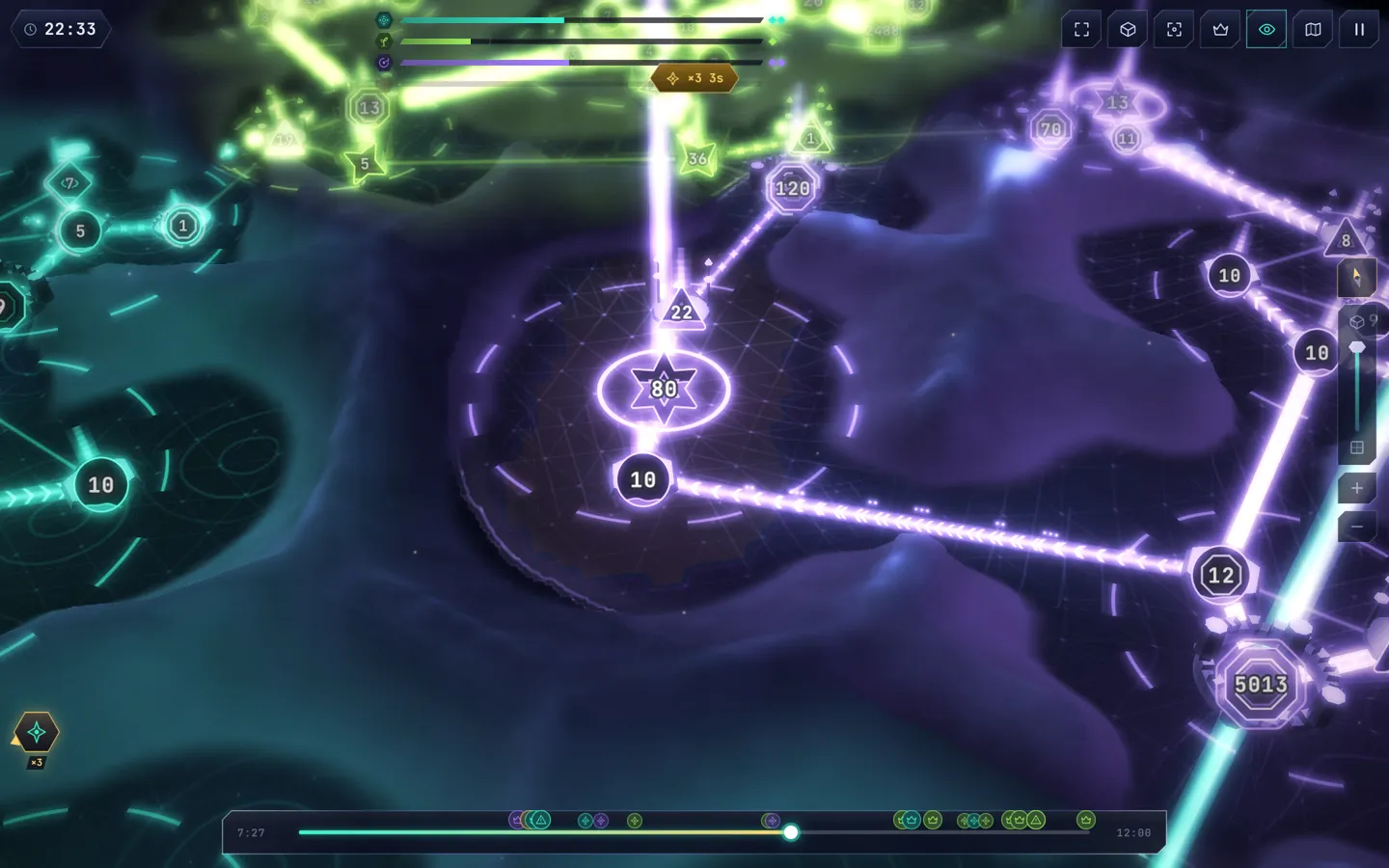
On the menu, in replays and when you spectate, the camera now directs itself. It follows the biggest fights, cuts to a core as it falls, and slows time for a moment when it does. Move the camera to take over. And every war ends with the camera rising and circling the final map.
Replays now have a scrub bar, marked with the moments that mattered: a core falling, a spire changing hands, an empire’s end. Tap one to jump straight there. When the war is over, the results screen tells its story, and makes an image of the final map to share. Replays can record a 20-second clip, too. Both are made on your device, and go only where you send them.
Brighter than ever.
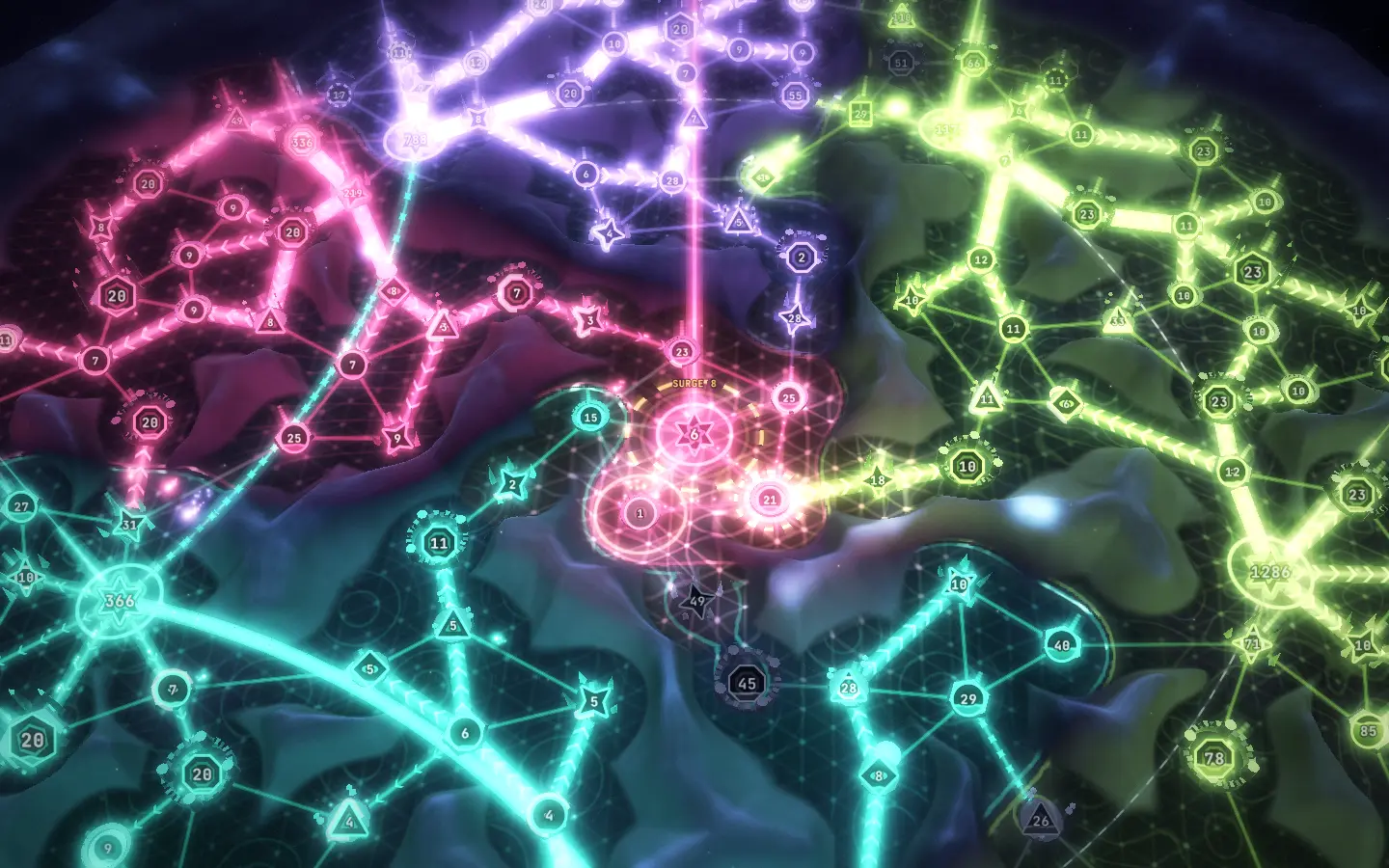
Battles now light up the world. Every strike, every capture, every river of mass casts coloured light across the ground and the mountains. Each faction’s land has its own pattern: rings, waves, facets, shards and vines. Borders under pressure crackle. Tilt the camera, and structures stand in 3D around every node, rising from the ground as they’re built. Beyond the island, the sky goes deeper. And the grid pulses softly with the music.

Better together.
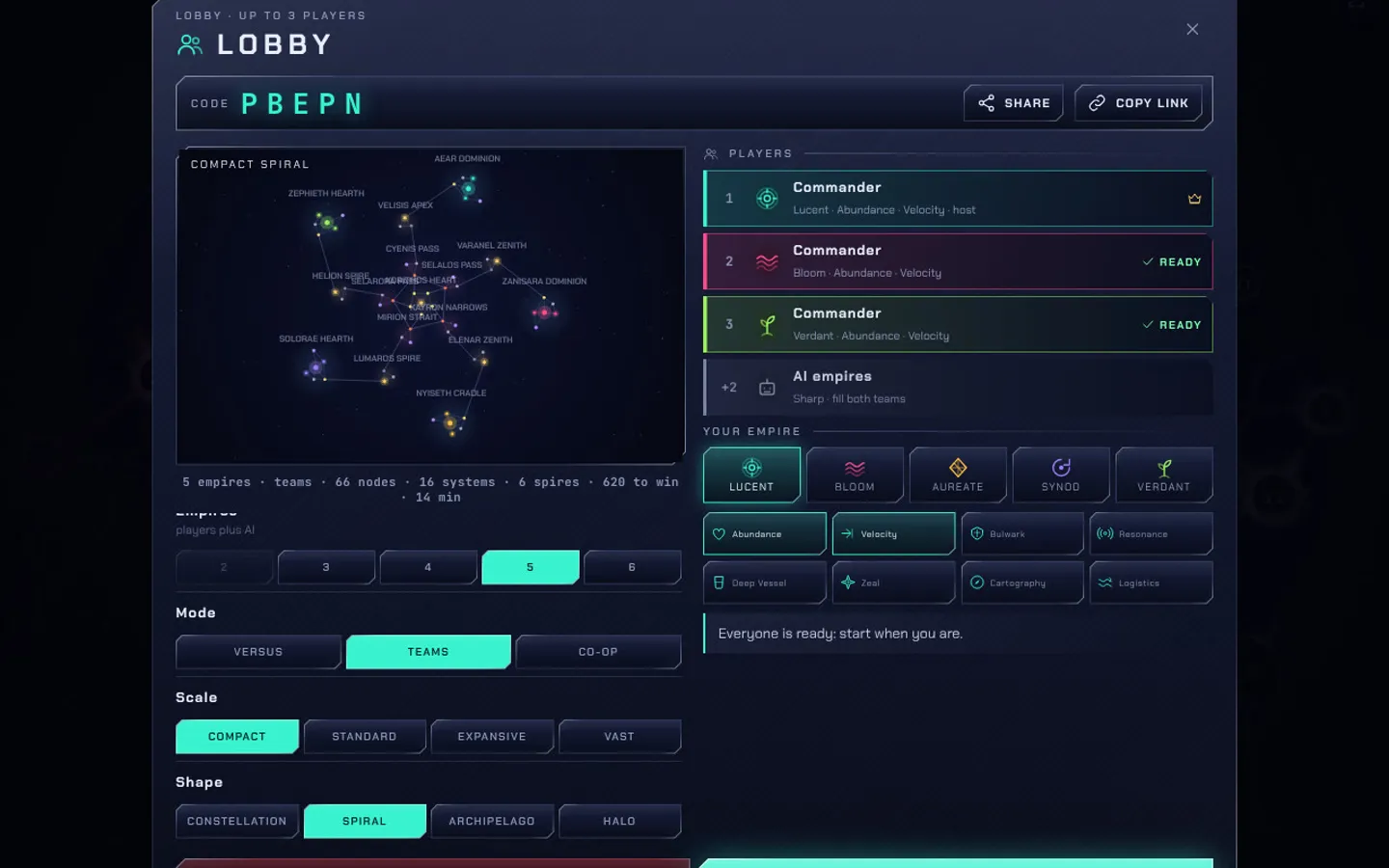
Create a private lobby for up to six players, and share its code or link with the people you want to invite. Pick your faction and doctrines, mark Ready, and the host chooses a generated world and a mode: Versus, Teams or Co-op. AI rivals fill any empty seats, and if someone leaves, an AI rival takes over their empire. Lobby matches are unranked. In team and co-op games, tap a node to signal your allies: Attack, Defend or Help. Allies and spectators see these fixed signals; there’s no player-written text. And online matches now send about eight times less data than before.
Made for more of you.
Controllers. Pick up a gamepad and play. The left stick moves a cursor, hold A to strike or sweep, hold X to draw a river, and Y opens the build menu.
A colour-blind palette. Switch it on in Settings, and every banner changes to colours chosen to stay distinct with red-green and blue-yellow colour blindness. Each faction’s land pattern gives you a second cue.
Phones. Tap a node, and it moves clear of its card, so you can still see the map.
Training. Three new short lessons teach building, star systems, and spans and bridgeheads.
Five factions, rebalanced.
The Lucent’s converging strikes now hit 60% harder. Bloom nodes struck in the last seven seconds now grow almost three times as fast. Aureate forces travel 38% faster, down from 45%. The Verdant Host grows faster, but its cut-off land slows to an eighth of its speed. Between equal rivals, every faction now wins between 22% and 28% of four-empire matches.
Good to know.
Had Lattice open during the update? Reload the page to play online.
Saves and replays from v16. They stay on your device, but the rules have changed, so v17 doesn’t show them.
Challenge links. Links from v16 still open, and their worlds now play by v17 rules.
Daily runs. A Daily run started before the update can’t be posted to the boards.
Ranked matches. A ranked match that was running when the update went live ended without a result. Nobody won or lost rating for it.
Your world awaits.
Lattice is free, in your browser, on your phone or computer. If you have a place, v17 is waiting for you. If you don’t yet, join the beta.
Screenshots and clips are from Lattice v17. Match lengths and win rates come from simulated matches between AI rivals (the faction figures from 360 four-empire matches), so games between people may run a little longer. Lattice is not offered in Australia, South Korea, mainland China, Vietnam, Indonesia or Brazil during the beta. In the EU/EEA and UK, solo play and unranked online features are available, including lobbies for up to six players in Versus, Teams or Co-op, Quick invite rooms, private-link spectating and optional Daily/challenge boards. Ranked matchmaking and persistent Elo ratings are unavailable there.